|
Biography | Artist’s Statement)
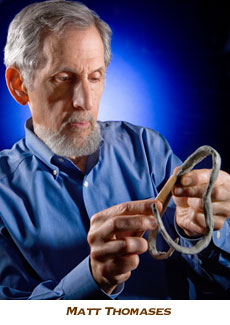 Matt Thomases began his passion for sculpting in his late 20’s after he had completed his education in history, economics and finance and had commenced a career in business and finance. In the mid-70’s, he worked as an apprentice at night to Michael Shacham, an accomplished Israeli sculptor who had a studio in the Soho district of New York. While he has taken many courses in sculpting and drawing, Thomases is essentially a self-taught artist who discovered that he has a gift for expressing motion, emotions and gestures through shapes.
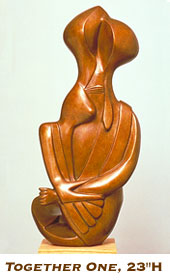
Thomases started casting abstract busts and more realistic busts in bronze in the late 1970’s and early 1980’s: The Silent Scream, Persian Queen, Faces, Ahab and others. He commenced figurative sculpting in the late 1980’s and early 1990’s. During this same period he created three busts of Van Gogh from his self-portraits. Subsequently, he did a bust of Francis Bacon as well as several figures inspired by that English artist’s sensual paintings. Thomases unusual landscape reliefs, initially inspired by the cubist works of Braque and Picasso, were created and cast from 1991 through 2001. In 2010, he complete another “corner” landscape relief, a swirling bronze shape in high patina inspired by three Van Gogh paintings.
Thomases began to enter local shows and art festivals in Brooklyn in the early 1990’s. His first solo show was held at the Joy Horwich Gallery in Chicago in 1996. He was selected for the juried competition “Sculpture in the Park” in Loveland, Colorado’s in 1997. Photographs of his works have been featured in several sculpture magazines. He received two awards from Manhattan Arts International, in 1998 and 2003.
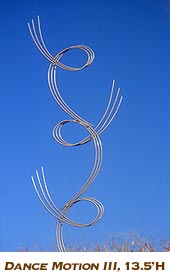
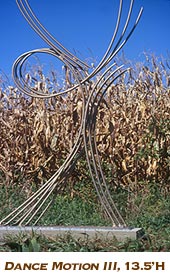
Throughout his artistic career one of Thomases’ main focuses has been on dance, mainly modern dance. He has explored many styles to communicate figures in motion. For the three bronze works inspired by Matisse, he used dancers as models. His first monumental work is a 7 ft. dancer, Tamar, completed in 2002. He studied welding at The Sculpture Center in New York in 1999 and 2000 and set up his own welding shop the following year. He has welded three versions of Dance Motion II, two 10 ft. and one 13 ft. In 2006, he completed a 14 ft. Dance Motion III that has four rhythmic motions. These steel works are all “drawings in space.” that capture the gesture and blur of dance.
In the mid-90’s, Thomases started exploring an imaginary world of abstract organic shapes, that is, bio-shapes that one might find in an imaginary world. Among the many charms of this “new species” is that they float on the surface; they have no roots. Between 2000 and 2005, Matt created an abstract group of three-sided “ferns” in bronze, each about 33” high. Two of these have been cast in clear translucent acrylic (like glass). Their shapes refract light and can be shown outdoors or indoors.
In 2001, Thomases decided to begin to more actively promote his works through gallery shows and competitions including some in gardens and parks. His sculptures have been on display in New York, New Jersey, Minnesota, Colorado, North Carolina, Virginia, Maryland, California, Vermont, Connecticut, Illinois and Massachusetts (see resume). Private collectors in New York, California, New Hampshire, Florida, Illinois, Massachusetts and Delaware own his works.
In 2002, Thomases and his wife traveled to China and became captivated by the rhythms of ancient Chinese calligraphy. He has now completed ten sculptures inspired by Tang and Ming dynasty calligraphic writing and by a modern Chinese artist’s who use traditional calligraphy. Thomases has transmuted the Chinese writing into music and dance motions and into anthropomorphic figures in motion.
Over the past decade, he has continued to do sculptures based on famous artists, completing a bust of Picasso and one of Jean Miró from their self-portraits. Each bust has other creations of the artists with in the sculpture.
In 2011 began actively planning a major sculpture of stainless steel and stained glass for outdoors. He completed the design and planning with the assistance of a special CAD program and a student from Rhode Island School of Design. He set up a construction site in a Quonset Barn on a farm. With the help of two assistants, he created Abstract Tree-Spring, a 15 ft. high piece that has over 850 pieces of stained glass interacting as the sun moves through the sky. Direct work on the sculpture took fourteen months. It was completed and installed in June, 2013.
For twenty years, Thomases has had art studios in Brooklyn where he lives and in Massachusetts where he has a summer-winter home. He welds on a farm in Pennsylvania. He balances his life of business consulting and sculpting and still has time for family, friends other interests. Matt is married to Jean Thomases, who is a consultant in education and community organizations. They have two married sons and four grandchildren.
Matt Thomases signs all of his sculptures with his Hebrew name, Mordecai ben Ysrael (MbY).
[Back to Top]
I am a three-dimensional artist. Shapes have always had meaning to me. The meanings cannot always be expressed in words. As a child, cloud shapes in the sky were like mythic sculptures. Air and flotation are part of my sculptures to this day. Nearly all my works, including the busts and landscape reliefs, involve rhythm and motion.
Several admirers of my work have described them as “lyrical.” They want to touch them and feel the shapes. I often listen to music when I am working in the studio: classical music, opera or jazz. There is a tactile sensuality in sculpting in clay and plaster. The music can influence the shapes.
I enjoy juxtaposing convexities and concavities in the same work or in paired pieces. My dancers not only have dominant shapes and clear rhythms, but they often form visually captivating negative spaces.
Dance is one of the main sources of stimuli for my art. As a child I studied music and was often taken to ballet. Now I am more inspired by modern dance. Dancers I, II, III are more classical. The Three Matisse Dancers are more modern. I believe that Matisse and Picasso played an important role in communicating and translating African dance into motions and rhythms that the Western mind could understand. In the last few years, I have created dance motions by bending and welding steel rods. I also found dance rhythms in Chinese Calligraphy. These minimalist works capture the dominant gesture of dance by drawing lines in space. The challenge for me in each of these groups is to communicate a dynamic visual art form (dance) using a static medium.
Why all the diversity? The joy of creating what my minds-eye sees is what pushes me to draw. I am accustomed to working on more than one piece at a time. The diversity enables me to actively sculpt one piece while struggling to solve problems on another. In short, the diversity helps my creativity. I enjoy the process, even if sometimes the frustrations and the uncertainties feel overwhelming. I suspect that most artists feel the same.
I am fortunate that my drawing pads are full of projects for the future. Sculptures take a long time to execute. Patience is part of the art form. Rushing is usually counter-productive. So I sculpt on, following my muse.
[Back to Top]
|